
There’s a particular smell that hits you when you open the door after the car has baked in a Cincinnati parking lot all afternoon. It’s not quite unpleasant, but it’s unmistakable — a warm, chemical tang of plastics and fabrics that have been cooking under the sun for hours. That smell is the scent of time doing its quiet work.
A car tells the truth in miles, not marketing. And in the heat of summer, it starts telling some very honest stories about how its interior is really holding up.
I’m Daniel Reeves, 44, still driving the same roads through Ohio, Indiana, and Kentucky. After enough blistering summers and freezing winters, I’ve watched interiors age in real time. Not the dramatic failures that make for good shop stories, but the slow, creeping changes that turn a once-fresh cabin into something that feels lived-in, loved, and slowly worn down.
The First Summer You Notice It
The first couple of years, the interior still feels new. The plastics have that fresh sheen. The fabric seats still spring back. The dashboard looks smooth and uniform. But around year three or four, especially here in the Midwest, the heat starts winning small battles.
I first noticed it clearly with my old 2008 Accord. One particularly brutal July day, I parked it at a client’s office for four hours. When I got back, the steering wheel was almost too hot to touch, and the top of the dashboard had that slightly soft, tacky feel. A year later, the first hairline cracks appeared near the defrost vents — tiny rivers forming in the plastic.
It wasn’t broken. It was just… aging. Like skin that’s spent too many summers without sunscreen.
What Heat Does to Plastic
Modern car interiors are mostly plastic. Different kinds, different qualities, but all of them react to repeated heating and cooling cycles.
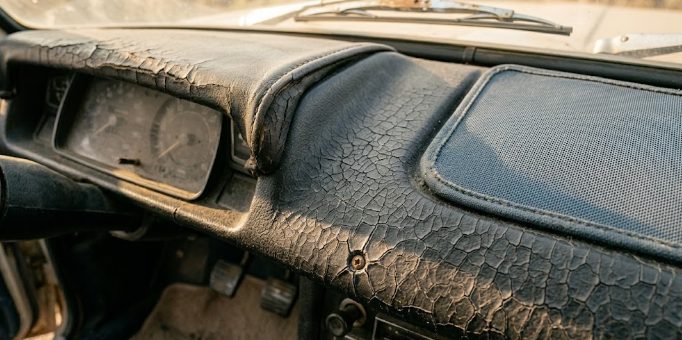
The dashboard is usually the first victim. That big, flat expanse absorbs sunlight like a solar panel. Over time, it fades, cracks, and sometimes even warps slightly. I’ve seen dashboards develop that classic “alligator skin” texture after six or seven hot seasons.
The door panels and center console follow. The once-matte black surfaces turn a bit shiny in spots from constant touching. The grain pattern starts to flatten. Little scratches that barely showed in year one become more obvious under bright summer light.
My current Outback is fighting the good fight, but even it shows the marks. The upper dashboard has a few faint stress lines, and some of the trim pieces around the radio have started reflecting light differently — a subtle sign that the material is breaking down at a microscopic level.
Fabric’s Slow Surrender
Cloth seats tell an even more personal story. They absorb everything: sweat on hot days, spilled coffee, kids’ snacks, dog hair, and the occasional muddy soccer cleat.
In the heat, fabrics breathe differently. They hold onto smells longer. The driver’s seat bolsters compress and develop permanent creases where your legs and hips live during all those miles. The fabric on the edges starts to pill or fray ever so slightly.
I remember the passenger seat in my old Camry. After years of my wife riding shotgun on errands, the cloth developed a distinct worn path exactly where she liked to rest her purse. It wasn’t dirty — just shaped by life. In summer, that area would get noticeably warmer and slightly stickier, like the fabric was giving up its original stiffness.
You learn a vehicle one ordinary day at a time. In summer, you learn it through the seat of your pants — literally.
The Hidden Life Under the Surface
Heat accelerates everything. Adhesives that hold headliners start to fail. You get that dreaded sagging fabric on the ceiling, especially above the rear seats. Door cards pull away from their mounts just a fraction. Rubber seals around windows and doors harden and shrink, letting in more wind noise over time.
Even the carpets change. They get more brittle. The rubber backing starts to crack in invisible places. One hot day you drop your keys and notice how the floor mat doesn’t lie as flat as it used to.
These changes are slow enough that you almost don’t notice them week to week. But pull up an old photo of the interior from when the car was new, and the difference hits you all at once.
The Midwest Summer Penalty
Living where we do means our cars endure real temperature swings. A car might go from freezing overnight to 95°F (35°C) inside by mid-afternoon. That constant expansion and contraction is brutal on materials.
Add in the brutal UV rays that come with clear summer skies, and you get accelerated fading. I’ve seen black interiors turn slightly purple or gray on the sun-facing surfaces. Reds and blues lose their richness. Even “premium” leather can dry out and crack if not conditioned regularly.
My advice after years of this: a good interior protectant and some window tint (where legal and not too dark) are worth their weight in gold. But even with care, time and heat still do their work.
Finding Beauty in the Wear
Here’s the thing though — there’s something honest and almost beautiful about a well-used interior that’s aged gracefully.
The worn places show exactly how you live with the car. The driver’s seat that’s molded to your posture. The steering wheel rim that’s slightly shinier where your hands rest at 9 and 3. The console that carries the ghost of every coffee cup you’ve ever set down.
These aren’t defects. They’re evidence of miles shared. Of life lived.
Some cars age like fine leather jackets — developing character and patina. Others age like cheap lawn furniture — cracking and fading without dignity. The difference often comes down to the original materials, how well you maintain them, and simple luck.
The Seasonal Reminder
Every summer I take a moment to really look at the interior while the sun is shining through the windows. It’s a good time to clean thoroughly, condition the leather or fabric, and address any small issues before they get worse.
It’s also a good time to appreciate what the car has already been through. That faded trim and those creased seats have stories. They’ve been there during family road trips, tough work weeks, quiet solo drives, and all the ordinary moments in between.
The slow interior life of a car is rarely talked about in reviews or on forums. But for those of us who keep cars for the long haul, it becomes part of the relationship. We watch our cars grow older with us. We accept their changing texture the same way we accept our own.
And when the heat beats down and that familiar warm-plastic smell fills the cabin, I don’t just smell aging materials. I smell memories. Thousands of them, baked in over the years.
That’s the quiet poetry of long-term ownership — watching something man-made slowly become something almost alive through time, heat, use, and care.
A car tells the truth in miles, not marketing. In summer, it tells that truth in faded fabric, softened plastic, and the honest wear of a life shared.

No comments yet — be the first to share a thought.